
.png)
For most of its history, rehabilitation has treated a patient's mistakes as the enemy. A hand drifts off course, and the instinct is to guide it back. An arm strays from the target, and the therapist gently corrects the path. This makes intuitive sense. It also runs against much of what we have learned about how the brain relearns movement.
A growing body of research points to a more surprising idea. The brain often learns fastest not when its errors are smoothed away, but when they are made larger. That single insight sits at the heart of Error Augmentation, and it is reshaping what state-of-the-art robotics can offer people recovering from stroke.
What the research actually showed
The foundational work here comes from a 2006 study published in Experimental Brain Research by James Patton, Mary Ellen Stoykov, Mark Kovic, and Ferdinando Mussa-Ivaldi, carried out through the Rehabilitation Institute of Chicago and Northwestern University. The team set out to answer two questions that had, until then, mostly been assumed rather than tested. The first was whether the adaptive machinery of a healthy brain survives a stroke. The second was whether patients gain more from training forces that shrink their errors or from forces that enlarge them.
Eighteen chronic hemiparetic stroke survivors made 834 reaching movements while a robot applied a force field that pushed their hands sideways, in proportion to how fast they moved. The design let the researchers watch how each person adapted, and then measure the after-effect once the forces were removed. That after-effect is the tell-tale sign of learning, the moment the nervous system reveals the internal model it has quietly built.
Two findings stand out. Stroke survivors did adapt, producing clear after-effects, which means the brain's capacity to recalibrate movement can persist even after significant injury. More striking still, meaningful improvement appeared in one condition only: when the robot magnified the person's existing errors. Forces that reduced error, or applied no disturbance at all, did not produce the same gains. The researchers also noted that the ability to adapt did not track neatly with standard clinical impairment scores, a reminder that recovery potential is not always visible in a bedside assessment.
The conclusion was measured, and it has held up across the roughly 400 studies that have since cited the work. Within this task, therapy that enhanced error proved more effective than therapy that guided the limb toward the correct path.
Why amplifying error works
The logic becomes clearer once you think about what the nervous system needs in order to change. Learning a movement is a process of prediction and correction. The brain guesses how much force a reach will take, the body moves, and the gap between the prediction and the result becomes the raw material for the next attempt. A larger, clearer gap gives the system a stronger signal to work with.
When a robot quietly assists, it narrows that gap. The movement looks better on the screen, yet the brain receives less of the very information it uses to improve. Amplifying the error does the opposite. It sharpens the contrast between intended and actual motion, which draws out a more vigorous corrective response and, with it, more durable motor learning. This is why the approach can feel counterintuitive at first. The harder path turns out to be the more productive one.
From laboratory finding to clinical tool
An elegant result in a controlled experiment is only the beginning. Turning it into daily therapy requires robotics precise enough to shape forces safely, responsively, and to a degree calibrated for each person. That engineering challenge is where Bioxtreme has focused its work.
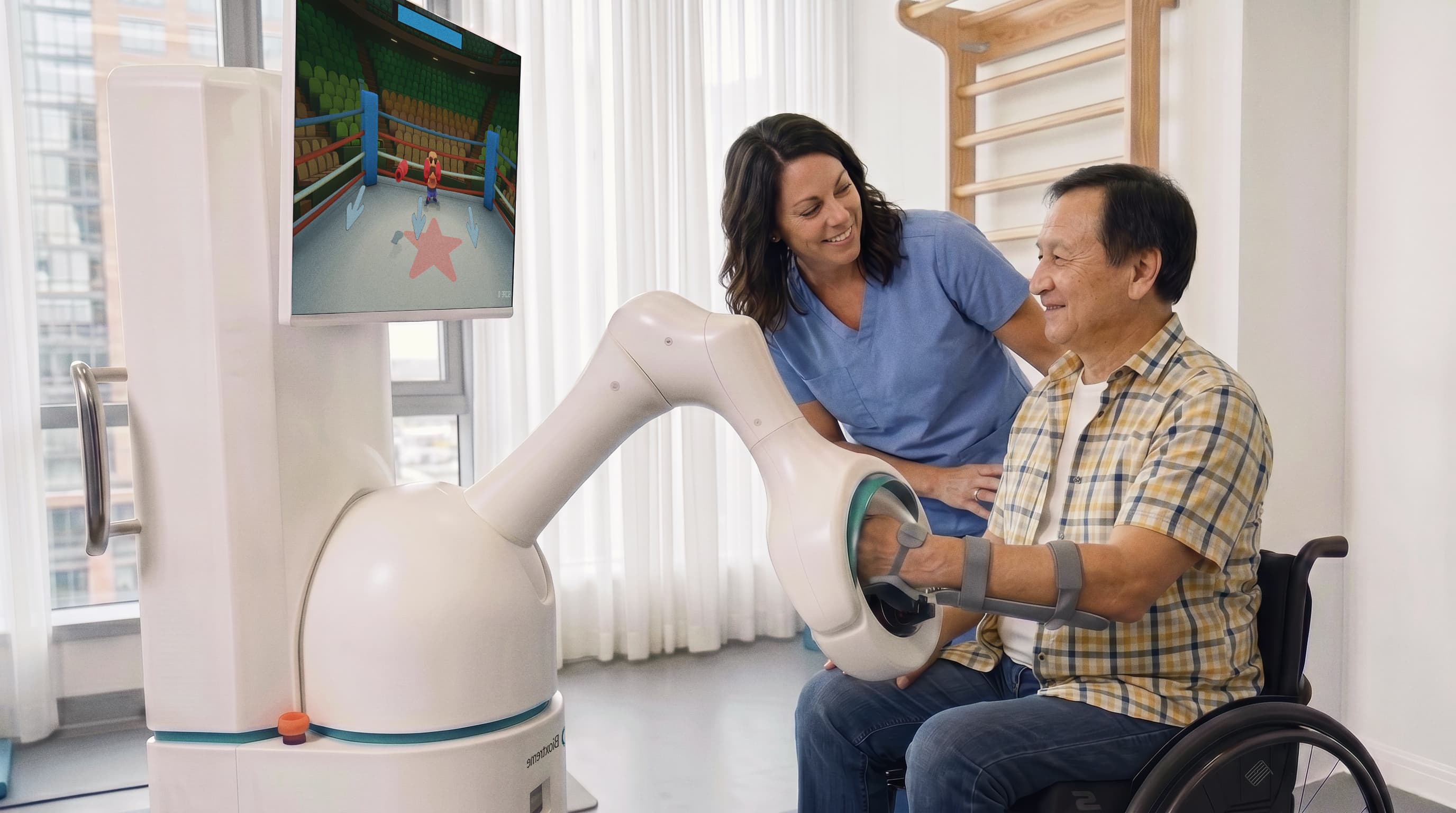
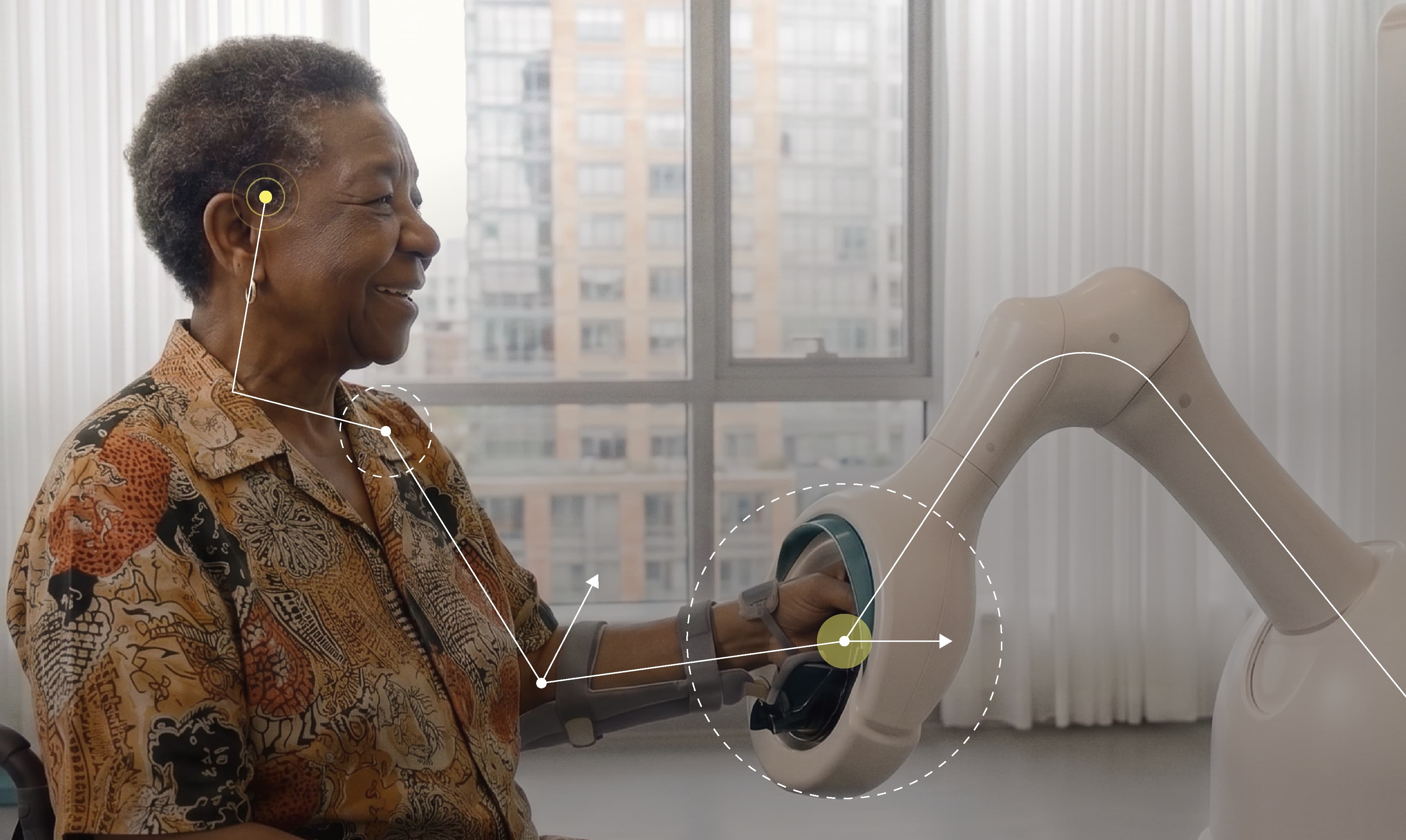
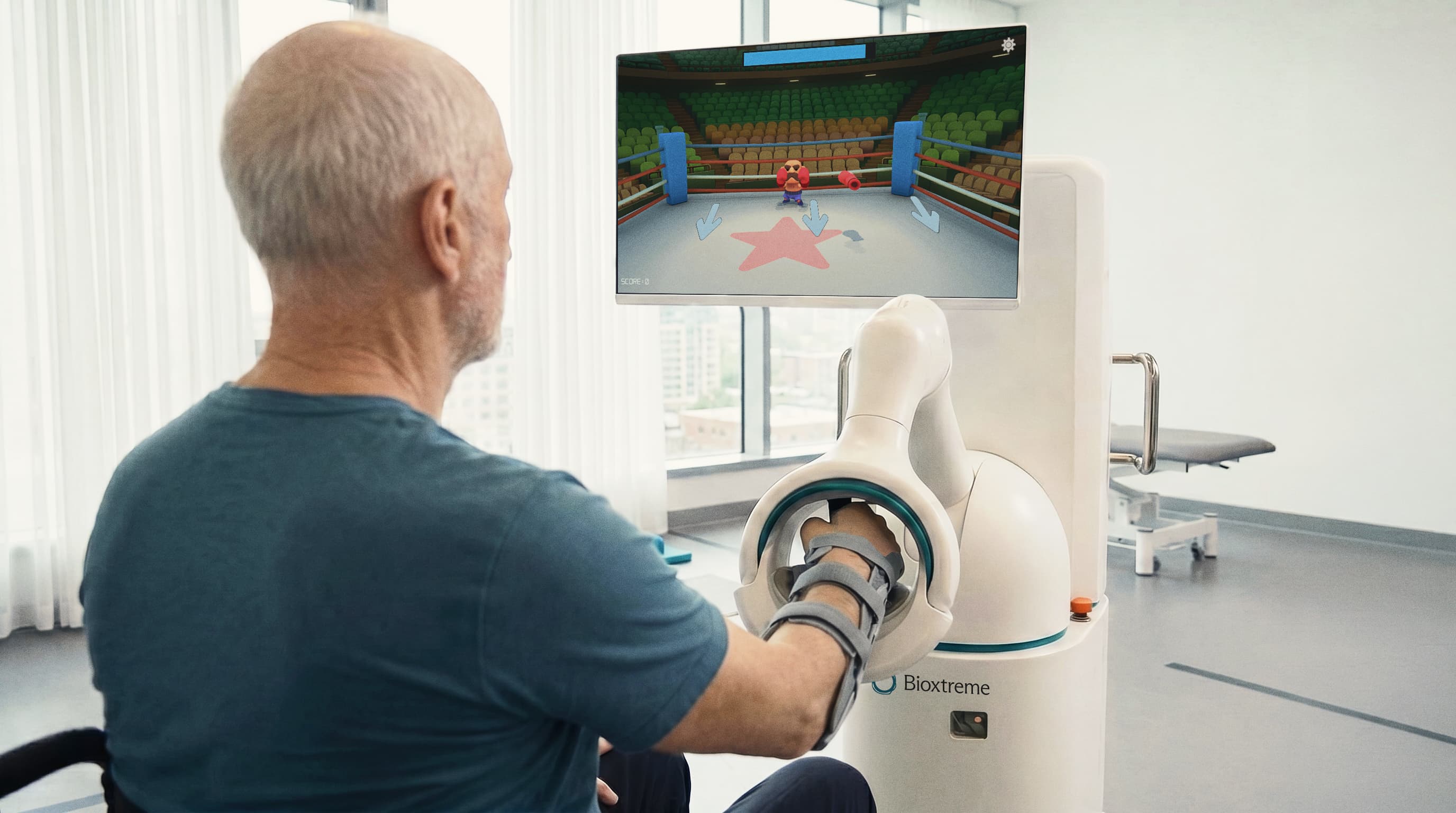
Bioxtreme's platform is built specifically around Error Augmentation for upper limb rehabilitation, delivered through two systems. Dextreme targets the shoulder, elbow, and arm across a full range of motion, while Plaxtreme concentrates on the hand and forearm, restoring grasp, release, and the rotation of the wrist. Both apply millimeter-scale force feedback, letting a therapist dial the challenge up or down so the amplified error stays useful rather than overwhelming. Every session produces data on range of motion, force, and accuracy, which gives clinicians a clear view of progress and lets them adjust the plan as recovery unfolds.
The early clinical signals are encouraging, and worth stating with appropriate care. In trials comparing Error Augmentation against standard robotic therapy delivered over the same number of sessions, Bioxtreme has reported roughly double the improvement in Fugl-Meyer and ARAT scores, along with a reduction in hand trajectory errors of nearly fifteen percent. Some measures, such as pinch strength, showed larger gains still. These are preliminary results from ongoing studies rather than final verdicts, and they point in a consistent and promising direction.
What this means for the field
The through-line from a 2006 reaching experiment to a modern FDA-cleared device is a case study in how good science reaches patients. The principle was established first, tested against the alternative, and only then engineered into a form a clinic can use every day.
For therapists, the practical shift is a change in instinct. Correction still matters, yet there is now solid reason to let patients wrestle with an amplified version of their own error, under conditions a robot can control precisely. For patients and families, the message is one of realistic hope. Recovery does not have to stall at the first plateau, and the discomfort of a harder task can be the sign that meaningful adaptation is underway.
Rehabilitation robotics has spent years chasing smoother, gentler assistance. The more interesting frontier may be the opposite one. Used with precision and care, error is not something to be corrected away. It is one of the most powerful teaching signals the recovering brain has, and technology built to harness it is beginning to show what that can mean for independence.
Sources: Patton JL, Stoykov ME, Kovic M, Mussa-Ivaldi FA. "Evaluation of robotic training forces that either enhance or reduce error in chronic hemiparetic stroke survivors." Experimental Brain Research, 2006, 168(3): 368–383. Clinical figures reflect Bioxtreme's reported trial results, including preliminary data from ongoing studies.
.png)
.png)

.jpg)

.jpg)