.png)
There is a question we get asked in almost every clinic we visit, and it usually arrives with a raised eyebrow. Can making a movement worse actually help someone recover faster after a stroke? It sounds like the opposite of everything rehabilitation is supposed to be about. For most of the last century, therapy has been built on a single instinct, which is to correct, to guide, and to reduce error wherever it appears. What we have learned, and what a growing body of clinical research now supports, is that the brain often learns fastest when we do the opposite.
I want to explain how that works, why it matters, and what it can mean for the person sitting in the chair trying to lift a cup of coffee for the first time in months.
The brain is a prediction machine
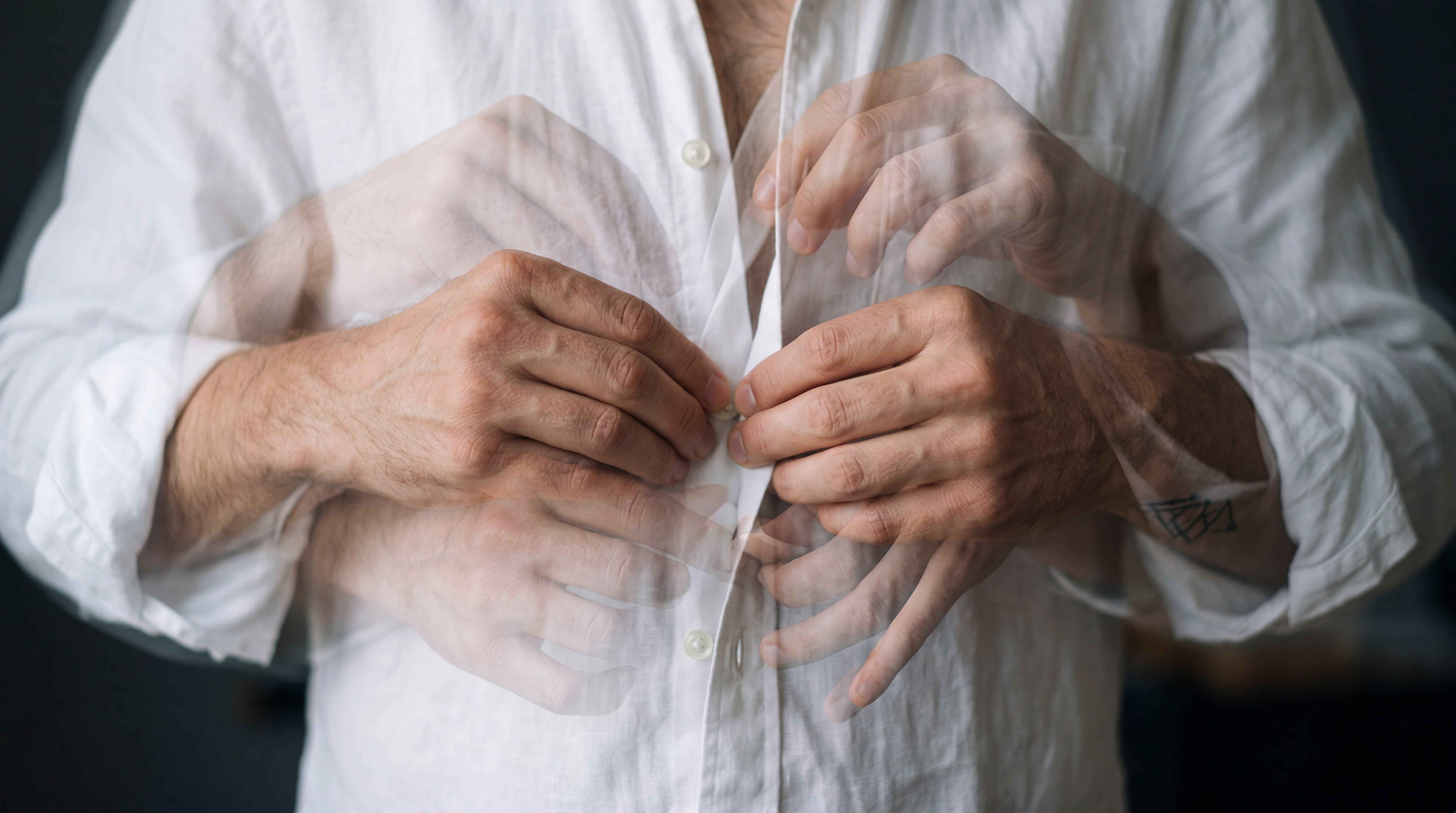
Before you reach for anything, your brain has already done the math. It predicts the exact forces your arm will need, and it programs your muscles accordingly, all in the fraction of a second before you move. You never notice this happening because it works so well. Reaching for a glass, turning a key, buttoning a shirt: each of these is a tiny prediction that your nervous system makes and then executes.
A stroke disrupts that prediction system. The brain's internal map of how much force a movement requires becomes unreliable, so the arm overshoots, undershoots, or drifts off course. The muscle is often still capable, but the signal that tells it what to do is what has been damaged.
Here is the part that gives us so much room to work with. The brain updates its predictions using error. When a movement does not go as planned, the size of that mismatch is exactly the signal the nervous system uses to recalibrate for next time. This is not a flaw in the system, it’s actually how every human being learned to move in the first place, from the infant reaching clumsily for a toy to the adult mastering a tennis serve.
Turning error into a teacher
Traditional robotic rehabilitation tends to hold the arm steady, smoothing out mistakes and guiding the limb along the correct path. That feels reassuring, and it has real value in the earliest and most fragile stages of recovery. The limitation is that a brain that is always corrected for has very little reason to correct itself.
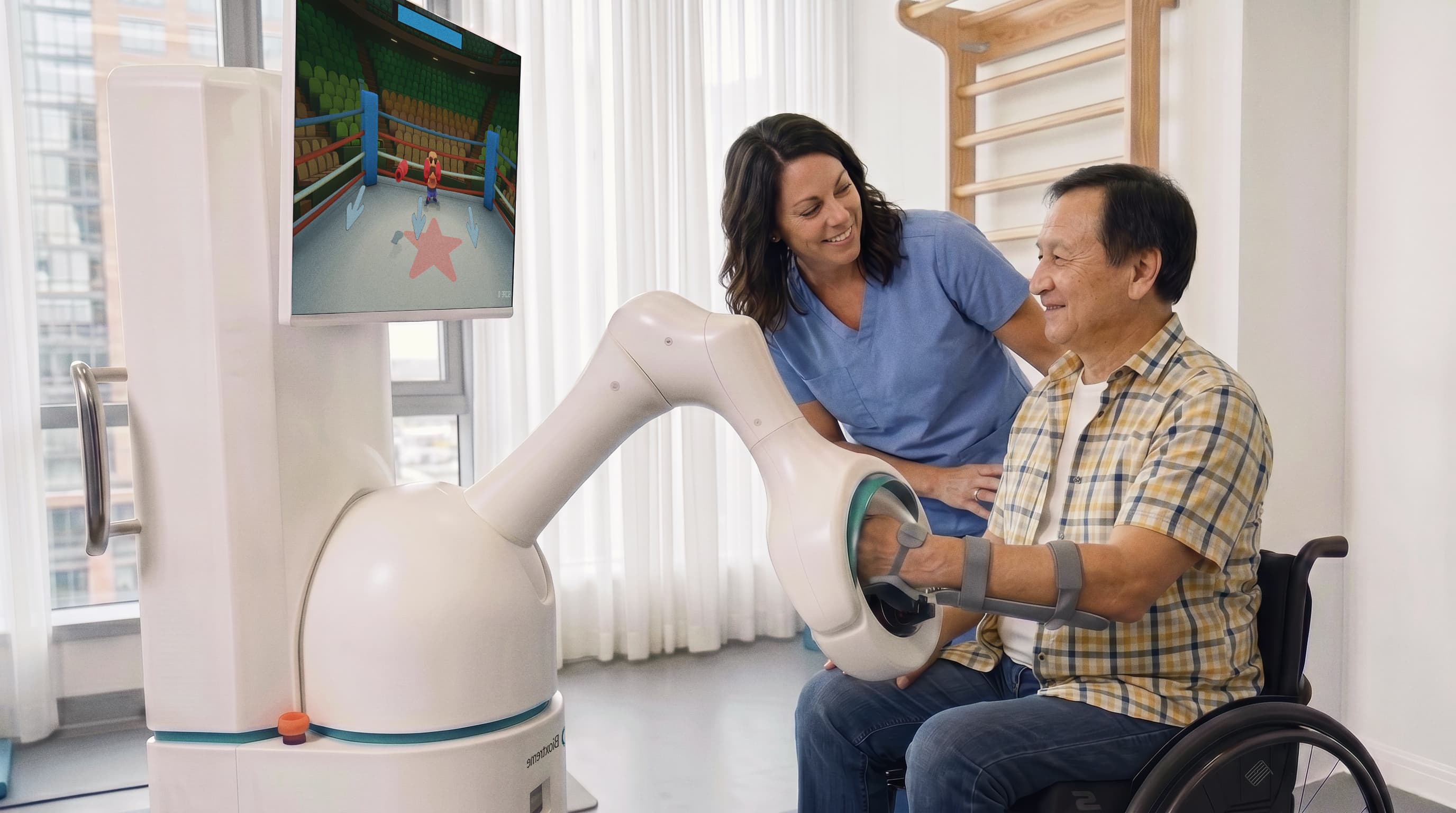
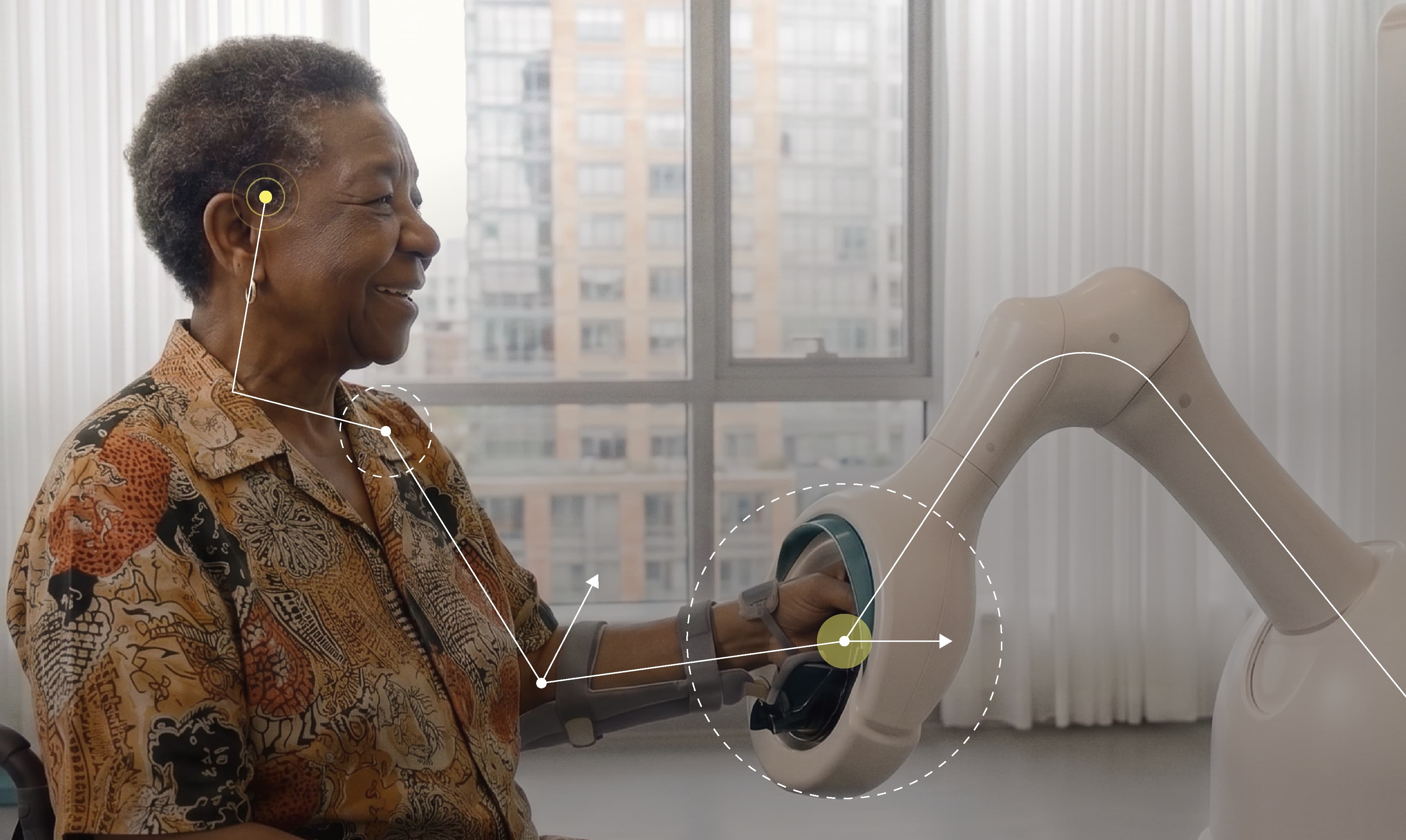
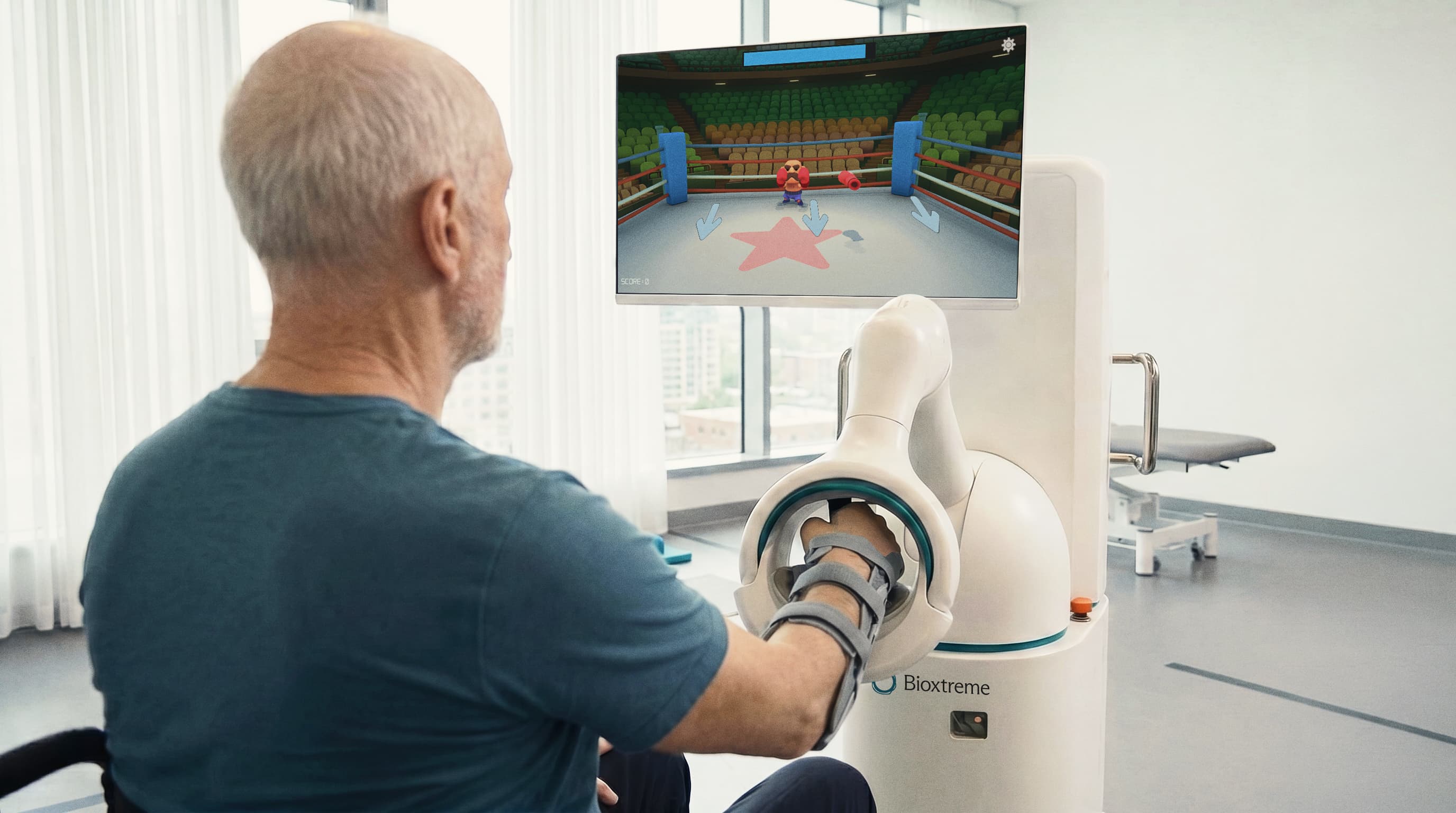
Error augmentation takes the opposite path. Our robotic devices measure a patient's movement in real time, and then apply a precise force that gently amplifies the error rather than erasing it. If the arm drifts to one side, the system nudges it a little further in that direction—subtly enough that the patient doesn't realize the force is there, yet enough to trigger the body's adaptive response—within safe and controlled limits. The nervous system feels the exaggerated mismatch and does what it is wired to do, which is to push back and correct. That instinctive correction is the moment of learning.
What I find most elegant about this approach is that it requires no conscious effort from the patient. There is no need to concentrate hard on the geometry of a perfect reach. The body responds to the amplified force on its own, through the same adaptive reflex that neuroscientists call an after-effect. Remove the force, and the newly corrected movement pattern remains. The patient has relearned the movement without ever being told how.
This is neuroplasticity in action, meaning the brain's lifelong capacity to rewire itself and form new connections. Error augmentation gives that capacity a stronger, clearer signal to work with, and the repeated corrections reinforce the neural pathways that control coordinated movement.
Why the technology matters more than the metaphor
A powerful idea is only useful if it can be delivered safely and precisely, session after session, to a real person with real limitations. This is where the engineering earns its place.
Every patient is different, and the same patient is different from one week to the next. Too little challenge and the brain has nothing to adapt to. Too much and the movement collapses into frustration. The therapeutic value lives in a narrow window between those two extremes, and that window keeps moving. Our systems use real-time machine learning to track each person's movement patterns, force, timing, and accuracy, building a personalized model of their ability and adjusting the level of error augmentation continuously to keep them in that productive zone. As a patient improves, the challenge rises to meet them. During a harder day, the assistance recalibrates so that progress never stalls into discouragement.
All of this happens inside an immersive, gamified virtual environment, which matters far more than it might first appear. Recovery after stroke is measured in hundreds of repetitions across many weeks, and motivation is often the difference between a plan that is followed and one that is abandoned. Turning the work into something engaging, with visible progress a patient can see and feel, keeps people coming back to the effort that recovery genuinely requires.
What the evidence shows
The reason I can speak about this with confidence is that the results are measurable, and they hold up against the standard that clinicians rightly demand.
In studies comparing our error augmentation therapy against robotic training without it, we have seen roughly twice the improvement in Fugl-Meyer scores, one of the most widely trusted measures of motor recovery, for individuals after stroke. We have recorded meaningful gains in muscle tone measures, greater movement precision, and in our hand and forearm work, substantial improvements in grasp, grip, and pinch strength. Several of these gains appeared within a two-week window, and some meaningful motor changes emerged in as few as six sessions.
Numbers like these matter to a researcher because they are specific and repeatable. They matter to a patient for a much simpler reason. Grip and pinch strength are not abstractions. They are the difference between depending on someone else to open a jar and doing it yourself in your own kitchen. Motor recovery of the shoulder and elbow is what lets a person raise their arm to hug a grandchild or reach a shelf without asking for help.
Our approach did not appear out of nowhere. It rests on more than two decades of research in motor learning, including foundational work from the robotics and rehabilitation science community, and it continues to be shaped by clinicians and engineers who hold us to a high bar. That combination of hands-on clinical insight and rigorous engineering is what keeps the technology honest.
A word to the person in the chair
If you are reading this while recovering from a stroke, I want to be direct with you about something that recovery can quietly steal, which is hope. Many people are told, gently but firmly, that they have reached a plateau, and that what they have regained is what they should expect to keep. I understand why that message is given, because conventional therapy does often reach a ceiling. What I want you to know is that a plateau is frequently a limit of the method, not a limit of your brain.
The brain's capacity to relearn does not switch off. It simply needs the right kind of signal, delivered often enough, at the right level of challenge, to start rebuilding. Watching someone regain a movement they had written off, sometimes months or years after their stroke, is the reason our team does this work at all.
Technology will not do the recovering for you, and I would never pretend otherwise. What it can do is meet your nervous system where it actually learns, turn your own instincts into your therapist, and make the long road of rehabilitation a little shorter and a great deal more encouraging. That is a future worth building, one corrected movement at a time.
.png)
.png)
.jpg)
.jpg)